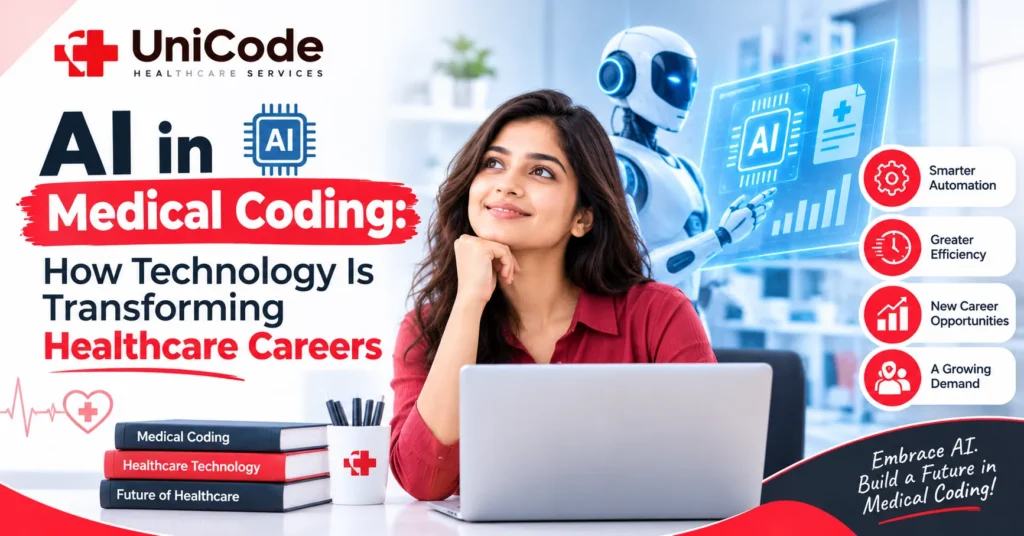
AI in Medical Coding: How Technology Is Transforming Healthcare Careers
AI in Medical Coding: How Technology Is Transforming Healthcare Careers Imagine a medical coder reviewing a patient’s medical record that contains multiple diagnoses, treatment details, laboratory reports, and physician notes. Earlier, the coder had to spend considerable time reading the documentation, identifying relevant information, and searching through coding manuals. Today, artificial intelligence can help complete some of these tasks in a much shorter time. This is how technology is beginning to change the medical coding industry. Artificial Intelligence (AI) is no longer limited to software development, banking, or digital marketing. It is gradually becoming part of healthcare operations, including medical documentation, billing, clinical data management, and medical coding. But what does this mean for someone planning to enter the medical coding profession? Will AI make coding easier? Will companies expect different skills from medical coders? And most importantly, how can students prepare themselves for these changes? If you are exploring a career in medical coding, understanding the relationship between AI and healthcare is becoming increasingly important. Let’s explore how AI is transforming medical coding and what these developments could mean for future healthcare professionals. What Is AI in Medical Coding? Artificial Intelligence in medical coding refers to the use of intelligent computer systems to analyse healthcare documentation, identify clinical information, and assist with assigning appropriate medical codes. Traditionally, medical coders review patient records manually and use standardised coding systems to classify diagnoses and procedures. AI-powered tools can support this process by identifying medical terms, extracting relevant information, and suggesting possible codes based on the documentation. For example, when a physician documents a patient’s condition, an AI-assisted system may identify the diagnosis and recommend a corresponding ICD-10-CM code for the coder to review. However, the suggested code must still be checked against the complete documentation and applicable coding guidelines. AI is designed to support coding activities, not automatically replace the knowledge and responsibility required from qualified professionals. How Is Artificial Intelligence Changing Medical Coding? The growing use of AI is introducing new ways to handle medical records and coding-related tasks. Here are some important areas where this technology can make a difference. 1. Automated Medical Code Suggestions One of the most noticeable applications of AI is automated code suggestion. Medical coding professionals regularly work with ICD-10-CM, CPT, and HCPCS coding systems. Finding the correct code requires understanding the documentation and applying the relevant coding rules. AI-powered software can analyse clinical notes and suggest codes that may be relevant to the documented condition. For example, if a patient’s medical record mentions hypertension, the software may identify the condition and suggest a possible diagnosis code. The medical coder then verifies the documentation, checks the coding guidelines, and confirms whether the suggested code is appropriate. This can reduce some manual searching and make the coding workflow more efficient. 2. Faster Medical Documentation Review Healthcare records can contain lengthy physician notes, discharge summaries, laboratory reports, and treatment information. Reading every document carefully requires time and concentration. AI-based tools can help identify important clinical information within large documents. They may highlight diagnoses, procedures, medications, and other relevant details for further review. This allows medical coders to focus their attention on information that requires careful interpretation. 3. Better Identification of Coding Errors Even experienced medical coders can encounter documentation issues or coding errors, particularly when handling complicated records. AI-assisted systems can help identify potential inconsistencies, missing information, duplicate entries, and unusual coding patterns. For example, a system may flag a code combination that requires additional review or identify a possible mismatch between the documented diagnosis and the selected code. These alerts can help coding teams identify problems earlier. However, automated alerts should not be treated as final decisions. Every finding needs to be evaluated according to the applicable coding rules. 4. Improved Medical Billing Processes Medical coding and medical billing are closely connected. Incorrect coding can contribute to claim rejections, payment delays, and additional administrative work. AI and automation can support different stages of the billing process by identifying missing information, checking certain claim details, and highlighting possible errors before submission. When implemented properly, these technologies may help healthcare organisations reduce repetitive work and improve administrative efficiency. 5. Supporting Healthcare Data Management Hospitals and healthcare organisations generate large volumes of patient information every day. AI can help organise and analyse this information, making it easier to identify patterns and retrieve relevant clinical details. Accurately coded healthcare information also supports research, reporting, disease tracking, and healthcare planning. Medical coding therefore plays an important role beyond billing and insurance claims. Which Medical Coding Systems Are Used Alongside AI? Even as technology advances, understanding standardised coding systems remains essential. AI tools work with healthcare information, but medical coding professionals need to understand the systems used to classify diagnoses and procedures. Some of the major coding systems include: ICD-10-CM: Used to classify diseases, diagnoses, symptoms, and other health conditions in the United States. CPT: Used to describe medical procedures and professional healthcare services. HCPCS Level II: Used to identify certain medical supplies, equipment, products, and services. ICD-10-PCS: Used to report inpatient hospital procedures in the United States. A medical coder should understand how these systems work rather than depending entirely on automated suggestions. Technology may help identify a possible code, but the professional must understand why that code is appropriate. Will AI Replace Medical Coding Professionals? This is one of the biggest questions among students considering medical coding as a career. The introduction of AI may automate certain repetitive activities, but medical coding involves much more than identifying medical terms and selecting corresponding codes. Consider a patient record that mentions diabetes, hypertension, and other medical conditions. An AI system may recognise these terms and suggest possible codes. However, the coder must determine whether the conditions are relevant to the encounter, whether the documentation supports reporting them, and which coding guidelines apply. This requires knowledge of medical terminology, anatomy, clinical documentation, and coding conventions. Human review is also important when documentation is incomplete, unclear, or complicated. Instead of viewing AI as