Best Medical Coding Training Institute in Bangalore & Hyderabad

Author name: Admin

medical-coding-career-2026-bangalore
Blog

Stuck in a Low-Paying Job? Start a Medical Coding Career in 2026

Stuck in a Low-Paying Job? Start a Medical Coding Career in 2026 Are you working hard every day but still feel like your salary and career growth have reached a dead end? You are not alone. Many graduates and working professionals want to move into a better career but hesitate because changing industries can feel risky. If you already have a background in life sciences, healthcare, pharmacy, biotechnology, or a related field, there may be a career path worth exploring without spending years going back to college. Medical coding is one such option. As healthcare organizations continue to depend on accurate clinical documentation, coding, billing, claims, and revenue-cycle processes, trained professionals are needed to handle these responsibilities. For the right candidate, medical coding can become a practical entry point into the healthcare industry. But before you leave your current job or join a course, it is important to understand what the career actually involves and how you can prepare for it. What Is Medical Coding? Medical coding is the process of converting information from medical documentation into standardized codes. When a patient visits a hospital, clinic, or healthcare provider, the medical record can contain diagnoses, symptoms, procedures, treatments, and other clinical information. A medical coder reviews this documentation and assigns appropriate codes according to established coding systems and guidelines. Some of the major coding systems include: ICD-10-CM for diagnosis coding CPT for many medical procedures and professional services HCPCS Level II for various healthcare services, supplies, and products Medical coding plays an important role in healthcare administration, claims processing, reporting, and reimbursement. Why Are Professionals Moving Toward Medical Coding? A low salary isn’t always the only reason someone considers a career change. Sometimes the real problem is a lack of growth, learning, stability, or a clear career path. Medical coding attracts people from different educational and professional backgrounds because it combines healthcare knowledge with analytical and documentation-based work. For graduates who don’t want a clinical career, it can provide another way to work within the healthcare industry. However, medical coding isn’t a shortcut to instant success. Like any professional career, it requires training, practice, accuracy, and continuous learning. Who Can Consider a Career in Medical Coding? Medical coding can be particularly interesting for graduates with backgrounds in: Life Sciences Biotechnology Microbiology Biochemistry Pharmacy Nursing Allied healthcare Other healthcare-related disciplines Graduates from other backgrounds may also explore the field, but they may need to spend additional time building their medical knowledge. If you already understand basic biology, anatomy, physiology, or medical terminology, you may have a useful foundation to build upon. What Does a Medical Coder Actually Do? A medical coder’s day isn’t simply about looking up codes. Depending on the role, responsibilities may include: Reviewing medical records Understanding provider documentation Identifying diagnoses and procedures Applying coding guidelines Assigning appropriate codes Checking documentation for accuracy Reviewing coding-related issues Maintaining coding quality Working with quality or auditing teams The ability to understand the documentation behind a code is one of the most important skills for a successful coder. Skills You Need to Build in 2026 If you’re serious about moving into medical coding, don’t focus only on memorizing codes. Build a strong foundation. 1. Medical Terminology You should be comfortable with common medical terms, abbreviations, diseases, procedures, and clinical language. 2. Anatomy and Physiology Understanding the human body helps you interpret medical documentation more effectively. 3. ICD-10-CM You need to understand how diagnosis codes are structured and how coding guidelines influence code selection. 4. CPT Knowledge of CPT is important for understanding how many procedures and professional services are reported. 5. HCPCS HCPCS Level II covers various services, supplies, and healthcare products. 6. Coding Guidelines Knowing the rules behind coding decisions is more valuable than simply memorizing codes. 7. Attention to Detail A small documentation detail can change a coding decision. Accuracy is therefore extremely important. 8. Analytical Thinking Medical records aren’t always straightforward. You need to understand the documentation and determine how the applicable guidelines should be applied. 9. Communication Skills Medical coders work as part of larger healthcare teams, so clear communication is useful for professional growth. Is Certification Important for Medical Coders? Certification can demonstrate your knowledge and commitment to the profession. One certification that many aspiring professional coders consider is the CPC (Certified Professional Coder) credential. Depending on your career goals, there are also other professional certifications related to areas such as: Inpatient coding Risk adjustment coding Specialty coding Professional coding Healthcare coding and compliance The right certification depends on the type of coding career you want to pursue. If you’re searching for CPC certification in Bangalore, don’t look only at the certification exam itself. Pay attention to the quality of preparation, practical coding exercises, trainer support, and your understanding of the underlying concepts. Why Practical Training Matters Imagine learning to drive by reading a driving manual but never sitting behind the wheel. You may know the rules, but applying them in real situations is different. Medical coding works in a similar way. You can memorize ICD-10-CM codes, CPT concepts, and medical terminology, but real medical records can contain complex documentation. That is why practical training should include: Sample medical records Case-based exercises Coding practice ICD-10-CM exercises CPT practice HCPCS concepts Coding guideline application Mock assessments Interview preparation When comparing best medical coding courses in Bangalore, look at the practical component rather than choosing a program simply because it has a short duration. How to Choose the Best Medical Coding Institute in Bangalore Bangalore has a large healthcare and technology ecosystem, making it an attractive location for people exploring healthcare-related careers. But choosing the right institute requires some research. When comparing the best medical coding institutes in Bangalore, ask: What topics are covered? Is the curriculum updated? Are medical terminology and anatomy included? Does the training cover ICD-10-CM, CPT, and HCPCS? Are practical case studies provided? Are trainers experienced? Is certification preparation included? Is interview preparation provided? Is career guidance available? Can students ask questions and receive
medical coding interview questions
Blog

Medical Coding Interview Questions Freshers Should Prepare for in 2026

Medical Coding Interview Questions Freshers Should Prepare for in 2026 You’ve completed your medical coding course, updated your resume, and finally received the interview call. Then the interviewer asks: “What is medical coding?” Suddenly, all those codes you studied don’t seem quite as easy as they did in class. Don’t worry. Medical coding interviews for freshers are usually less about memorizing hundreds of codes and more about checking whether you understand medical terminology, anatomy, coding guidelines, ICD-10-CM, CPT, HCPCS, and basic coding concepts. If you’re preparing for your first medical coding job in 2026, knowing the questions interviewers commonly ask can help you walk into the interview with much more confidence. Below are 25 important medical coding interview questions and answers for freshers. 1. What is Medical Coding? Answer:Medical coding is the process of converting information from healthcare documentation into standardized medical codes. These codes represent diagnoses, procedures, services, and other healthcare information. Common coding systems include ICD-10-CM, CPT, and HCPCS Level II. 2. What Is the Difference Between Medical Coding and Medical Billing? Answer:Medical coding focuses on reviewing medical documentation and assigning appropriate diagnosis and procedure codes. Medical billing focuses more on using that coded information to prepare and submit claims, follow up on payments, manage denials, and support reimbursement. In simple terms: Coding = Documentation → Codes Billing = Codes → Claims → Reimbursement Both functions work together within the healthcare revenue cycle. 3. What Is ICD-10-CM? Answer:ICD-10-CM stands for International Classification of Diseases, 10th Revision, Clinical Modification. It is used primarily to report diagnoses and health conditions in healthcare settings. A coder uses the documentation and applicable coding guidelines to select the appropriate ICD-10-CM code. 4. What Is CPT? Answer:CPT stands for Current Procedural Terminology. CPT codes are used to report many medical procedures, services, and professional healthcare services. CPT codes are maintained by the American Medical Association (AMA). 5. What Is HCPCS? Answer:HCPCS stands for Healthcare Common Procedure Coding System. HCPCS Level II codes are commonly used to report various products, supplies, services, and items that aren’t represented by CPT codes. For example, certain medical supplies, ambulance services, and durable medical equipment may be reported using HCPCS Level II codes. 6. What Is the Difference Between ICD-10-CM and CPT? Answer: ICD-10-CM primarily represents diagnoses and conditions. CPT primarily represents procedures and professional services. For example, a patient’s diagnosis may be represented using an ICD-10-CM code, while a procedure performed during the encounter may be reported using a CPT code. 7. What Is Medical Necessity? Answer:Medical necessity generally means that a healthcare service or procedure is appropriate and supported by the patient’s condition and clinical circumstances. In coding and billing, documentation and payer requirements help determine whether the reported service is supported. A coder should never assume medical necessity without appropriate documentation and applicable guidelines. 8. What Is a Modifier? Answer:A modifier is used with certain procedure codes to provide additional information about how, where, or under what circumstances a service was performed. Modifiers can provide important details without changing the basic procedure code itself. Examples include Modifier 25 and Modifier 59, although their use depends on specific coding circumstances. 9. What Is Modifier 25? Answer:Modifier 25 is used to indicate that a significant, separately identifiable evaluation and management service was performed by the same physician or other qualified healthcare professional on the same day as another procedure or service, when the documentation supports its use. A common interview follow-up is: “Can Modifier 25 be used simply because two services were performed on the same day?” The answer is no. The documentation must support the requirements for separately reporting the E/M service. 10. What Is Modifier 59? Answer:Modifier 59 is used to indicate that a procedure or service was distinct or independent from another service performed on the same day. It may be appropriate in circumstances involving factors such as a different encounter, procedure, site, organ system, or other qualifying circumstances, depending on the coding rules. It should not be added automatically just to bypass a code-edit issue. 11. What Is a Principal Diagnosis? Answer:For inpatient coding, the principal diagnosis is generally the condition established after study to be chiefly responsible for the admission of the patient to the hospital. The exact determination must follow the applicable official coding guidelines. For outpatient coding, the terminology and sequencing rules are different, so a coder should understand the distinction. 12. What Is a First-Listed Diagnosis? Answer:In many outpatient settings, the first-listed diagnosis is generally the diagnosis, condition, problem, or other reason chiefly responsible for the services provided during the encounter. The correct selection depends on the documentation and the applicable outpatient coding guidelines. 13. What Is Upcoding? Answer:Upcoding occurs when a healthcare service or condition is reported using a code that represents a higher level or greater severity than what is supported by the documentation. For example, reporting a higher-level service without documentation to support that level can be considered upcoding. Accurate coding requires following documentation and coding guidelines rather than trying to increase reimbursement. 14. What Is Downcoding? Answer:Downcoding generally refers to reporting a lower-level code than the service or condition that is appropriately supported by the documentation. Both upcoding and inappropriate downcoding can create problems with coding accuracy and reimbursement. The objective of a professional coder is accurate coding, not maximizing or minimizing payment. 15. What Is a Coding Guideline? Answer:Coding guidelines are rules and instructions that help coders determine how diagnoses and procedures should be reported. They help with areas such as: Code selection Sequencing Combination codes Excludes notes Signs and symptoms Documentation requirements Specific coding situations A good coder doesn’t just memorize codes—they understand how to apply the relevant guidelines. 16. What Is the Difference Between a Symptom and a Diagnosis? Answer:A symptom is something experienced or reported by the patient, such as pain, fever, nausea, or shortness of breath. A diagnosis is a condition identified or documented by the healthcare provider. When a definitive diagnosis has been established, the applicable coding guidelines determine

medical coding vs medical billing
Blog

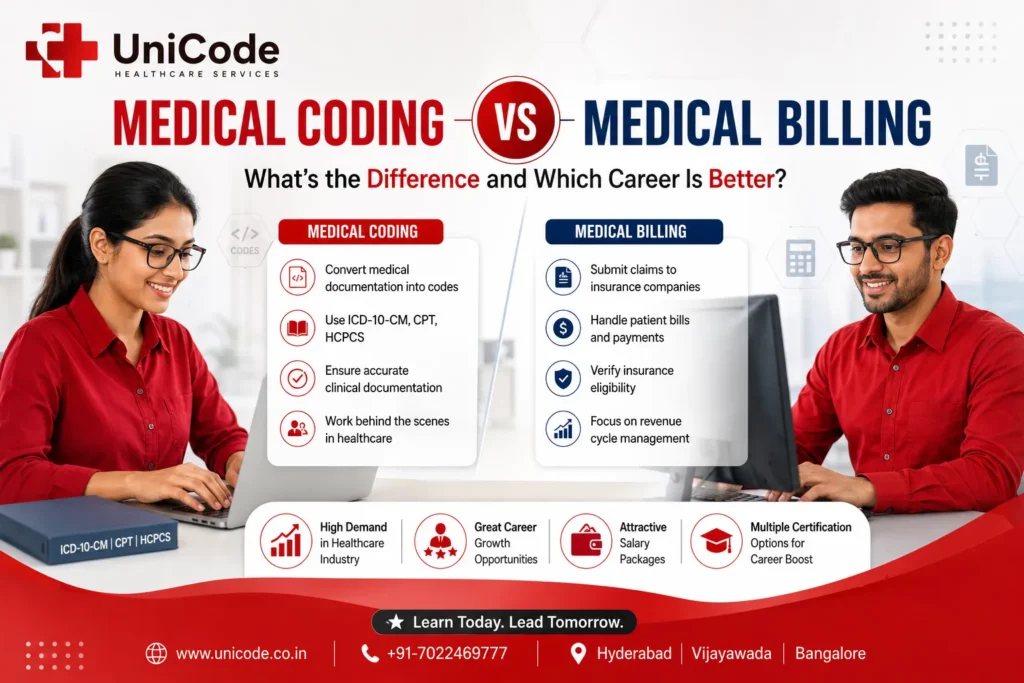
Medical Coding vs Medical Billing: What’s the Difference and Which Career Is Better?

Medical Coding vs Medical Billing: What’s the Difference and Which Career Is Better? Medical coding and medical billing are often treated as the same career—but they are not. Both are important parts of the healthcare revenue cycle, and both offer career opportunities for graduates who want to work in the healthcare industry without entering a clinical profession. But what exactly does a medical coder do? What does a medical biller do? Which one requires more medical knowledge? Which career is better for freshers? And should you choose coding, billing, or learn both? If you’re considering a healthcare career, understanding these differences before joining a course can save you from making the wrong choice. What Is Medical Coding? Medical coding is the process of converting information from a patient’s medical records into standardized medical codes. A medical record can contain diagnoses, symptoms, procedures, treatments, and other clinical information. The coder reviews this documentation and assigns the appropriate codes according to established coding guidelines. Some of the major coding systems include: ICD-10-CM – mainly used for diagnosis coding CPT – used for reporting medical procedures and professional services HCPCS Level II – used for various healthcare services, supplies, and products A medical coder needs to understand medical terminology, anatomy and physiology, documentation, and coding guidelines. The job is not simply about finding a code in a book or software. A good coder needs to understand the clinical information and determine which code accurately represents the documented condition or service. What Is Medical Billing? Medical billing is more closely connected to the financial side of healthcare. Once medical services have been documented and coded, billing professionals work with that information to prepare and submit claims to insurance companies or other payers. A medical biller’s responsibilities may include: Preparing healthcare claims Submitting claims to insurance companies Checking claim status Identifying rejected or denied claims Following up on unpaid claims Reviewing payment information Maintaining billing records Communicating with insurance companies and healthcare organizations In simple terms, medical coding translates healthcare documentation into codes, while medical billing uses that coded information as part of the reimbursement process. Medical Coding vs Medical Billing: The Key Difference The easiest way to understand the difference is to look at their primary responsibilities. Medical Coding Medical Billing Reviews medical documentation Works with claims and payments Assigns diagnosis and procedure codes Prepares and submits claims Requires strong medical terminology knowledge Requires understanding of billing processes Focuses on coding accuracy Focuses on reimbursement and claim processing Uses ICD-10-CM, CPT, HCPCS Works with coded information and payer requirements More closely connected to clinical documentation More closely connected to financial processes Although the two functions are different, they work together. An incorrect code can affect a claim, and an error during billing can delay reimbursement. This is why healthcare organizations need professionals who understand their responsibilities clearly. Which Career Is Better for Freshers? There isn’t one answer that applies to everyone. The better career depends on your interest, educational background, strengths, and long-term goals. If you enjoy medical terminology, anatomy, diseases, procedures, and analyzing medical records, medical coding may be a better fit. If you are more interested in claims, insurance processes, payments, documentation, and administrative work, medical billing may suit you better. And there is another option: Learn both. Having knowledge of medical coding and billing can help you understand the complete healthcare revenue cycle and may open the door to a wider range of entry-level roles. Medical Coding May Be a Good Choice for Life Science Graduates Students from B.Sc. and other life science backgrounds often already have exposure to subjects such as biology, anatomy, physiology, or related areas. That background can make it easier to understand medical terminology and clinical documentation. However, academic knowledge alone isn’t enough. A student still needs proper training in ICD-10-CM, CPT, HCPCS, coding guidelines, medical terminology, and practical coding scenarios. This is why many graduates search for best medical coding courses in Hyderabad when planning their transition into healthcare operations. What Skills Are Needed for Medical Coding? Medical coding requires a combination of healthcare knowledge and analytical ability. Medical Terminology You should understand common medical terms, abbreviations, diseases, procedures, and clinical language. Anatomy and Physiology A basic understanding of the human body helps you interpret medical documentation correctly. Coding Guidelines Knowing ICD-10-CM, CPT, and HCPCS is important, but understanding the rules behind code selection is even more important. Attention to Detail Medical records can contain a lot of information. One small detail can influence code selection, so careful reading is essential. Analytical Thinking Coders often need to interpret documentation and apply coding guidelines rather than simply match keywords. Communication Skills Clear communication can help when working with colleagues, quality teams, auditors, and other healthcare professionals. What Skills Are Needed for Medical Billing? Medical billing requires a somewhat different skill set. A medical billing professional should develop an understanding of: Healthcare claims Insurance processes Billing terminology Claim submission Payment posting Denial management Accounts receivable Follow-up procedures Basic medical terminology Communication and documentation Strong organizational skills can also be valuable because billing involves tracking claims, payments, and follow-ups. Medical Coding Certification vs Medical Billing Training Another important difference is the certification path. Medical coding professionals may choose certifications such as CPC, CCS, CIC, or CRC, depending on their career goals and specialization. For someone starting in coding, CPC certification is one commonly considered professional credential. Medical billing, on the other hand, is often entered through job-oriented training that focuses on billing processes, insurance claims, revenue cycle management, and related workflows. If you’re not sure which path to choose, learning the fundamentals of both medical coding and medical billing can help you understand which area suits you better. Choosing Medical Coding Training in Hyderabad Hyderabad has become a popular destination for students interested in healthcare-related careers. But choosing a training institute shouldn’t be based only on advertisements or promises. Before joining a course, look at the actual learning experience. Ask: Does the course cover ICD-10-CM? Is CPT included?

medical coding certification after B.Sc
Blog

Medical Coding After B.Sc: Career Options, Skills, Certifications & Jobs

Medical Coding After B.Sc: Career Options, Skills, Certifications & Jobs You have completed your B.Sc. degree. Now what? For many life science and healthcare graduates, this is where the real career question begins. A B.Sc. gives you a strong academic foundation, but finding a career that offers stability, professional growth, and opportunities in the healthcare industry can sometimes feel confusing. One career path that deserves attention is medical coding. Medical coding connects healthcare knowledge with the administrative and financial side of the healthcare system. Hospitals, clinics, healthcare companies, insurance organizations, and medical billing companies depend on accurate medical coding to process healthcare information and claims. For B.Sc. graduates who are interested in healthcare but don’t necessarily want to work in a laboratory or clinical setting, medical coding can be an interesting career option. What Is Medical Coding? Medical coding is the process of converting information from medical records into standardized codes. A patient’s medical record may contain diagnoses, procedures, symptoms, treatments, medications, and other clinical information. Medical coders review this documentation and assign appropriate codes according to established coding systems such as ICD-10-CM, CPT, and HCPCS. In simple terms, a medical coder takes complex healthcare documentation and translates it into standardized information that can be used for billing, insurance claims, reporting, and healthcare administration. This makes medical coding an important part of the healthcare revenue cycle. Is Medical Coding a Good Career After B.Sc? Yes, particularly for graduates from life science and healthcare-related backgrounds. Students with degrees such as B.Sc. Life Sciences, Biotechnology, Microbiology, Biochemistry, Zoology, Botany, and other related disciplines may already have an understanding of basic medical terminology, anatomy, physiology, and biological concepts. However, having a B.Sc. degree alone doesn’t make someone a medical coder. You need to understand how medical documentation is interpreted and how the correct codes are selected according to coding guidelines. That is where proper training becomes important. Career Options After Medical Coding Training Medical coding is not limited to one particular job title. As you gain knowledge and experience, several career paths can become available. 1. Medical Coder This is one of the most common starting positions. Medical coders review patient records and assign appropriate diagnosis and procedure codes. Freshers generally begin with entry-level coding responsibilities and gradually handle more complex records. 2. Medical Coding Associate Healthcare organizations may hire fresh graduates as coding associates or coding executives. These roles can involve reviewing documentation, assigning codes, maintaining accuracy, and following organizational coding standards. 3. Medical Billing Executive Medical coding knowledge can also be useful in medical billing. Billing professionals work with coded information to support claim submission, payment processing, and reimbursement activities. 4. Medical Claims Analyst Claims-related positions involve reviewing healthcare claims and checking whether the information is accurate and complete. Knowledge of coding and medical terminology can be valuable in these roles. 5. Quality Analyst With experience, medical coders can move into quality-focused positions. Quality analysts review coding work, identify errors, monitor accuracy, and help improve coding performance. 6. Medical Coding Auditor Auditing is another career direction for experienced professionals. Medical coding auditors examine coded records to identify compliance issues, documentation problems, and coding inaccuracies. 7. Specialized Coding Roles After gaining experience, coders can choose to develop expertise in specific areas such as: Inpatient coding Outpatient coding Emergency department coding Surgery coding Evaluation and Management (E/M) Risk adjustment coding HCC coding Specialty-specific coding Your career path will largely depend on your interests, certification, experience, and the type of healthcare organization you join. Skills You Need to Become a Medical Coder A successful medical coder needs more than memorizing codes. Medical Terminology You should be comfortable understanding common medical terms, abbreviations, diseases, procedures, and clinical language. Anatomy and Physiology Understanding how the human body works makes it easier to interpret medical documentation and understand diagnoses and procedures. ICD-10-CM Knowledge ICD-10-CM is widely used for diagnosis coding. You need to understand coding conventions, guidelines, sequencing, and documentation requirements. CPT and HCPCS Knowledge CPT codes are primarily used to report medical procedures and professional services, while HCPCS Level II codes cover various supplies, products, and services. Attention to Detail Small differences in medical documentation can affect code selection. Good coders carefully read records rather than simply searching for familiar terms. Analytical Thinking Sometimes the information in a medical record isn’t straightforward. Coders need to interpret documentation, follow guidelines, and determine the most appropriate coding approach. Communication Skills Although medical coding is largely documentation-based, communication is still important when working with team members, auditors, quality teams, and healthcare professionals. Continuous Learning Coding guidelines, payer requirements, healthcare practices, and industry expectations can change. A good medical coder keeps learning instead of treating certification as the end of education. Which Certification Is Useful After B.Sc? Certification can help demonstrate your coding knowledge to potential employers. One of the well-known credentials in professional medical coding is the CPC (Certified Professional Coder) certification offered by AAPC. Depending on your career goals, you can also explore certifications related to areas such as: Certified Coding Specialist (CCS) Certified Inpatient Coder (CIC) Certified Risk Adjustment Coder (CRC) Specialty-specific coding certifications You don’t necessarily need to collect multiple certifications at the beginning of your career. It is usually more useful to build a strong foundation first and then select a certification that matches your career direction. Why Practical Training Matters One common mistake students make is choosing a course based only on the certificate provided at the end. Medical coding is a practical skill. You need to learn how to read medical records, understand documentation, apply coding guidelines, identify relevant information, and select appropriate codes. A good training program should therefore combine theory + coding guidelines + medical terminology + anatomy & physiology + practical case studies + coding exercises. For students looking for medical coding training in Hyderabad, choosing a program that focuses on practical learning can make the transition from classroom learning to a workplace much easier. Choosing the Right Medical Coding Institute in Hyderabad Hyderabad has become an important destination

Medical Coding Career 2026
Blog

Medical Coding Career in 2026: Skills Employers Are Looking for Beyond Certification

Medical Coding Career in 2026: Skills Employers Are Looking for Beyond Certification Getting certified can open the door to a medical coding career. But in 2026, certification alone may not be enough to help you walk through that door. Think about it: two candidates can have the same CPC or other coding certification. One knows how to apply coding guidelines to real-world documentation, communicate clearly, work with EHR systems, identify documentation gaps, and maintain accuracy under productivity expectations. The other knows the theory but struggles when faced with an actual chart. Who is more likely to stand out? The answer is clear: the coder who can turn knowledge into practical results. As healthcare organizations continue to focus on coding accuracy, compliance, documentation quality, and efficient revenue-cycle operations, employers are increasingly interested in practical, job-ready skills—not just certificates. 1. Strong Knowledge of ICD-10-CM, CPT and HCPCS Certification gives you a foundation, but professional coding requires you to apply that knowledge correctly. A job-ready medical coder should be comfortable working with: ICD-10-CM diagnosis coding CPT procedure coding HCPCS Level II Medical terminology Anatomy and physiology Official coding guidelines Documentation requirements E/M coding concepts The goal is not simply to memorize codes. A good coder understands why a particular code is appropriate based on the documentation. That difference becomes extremely important when dealing with complex or incomplete medical records. 2. Real-World Chart Review Skills One of the biggest gaps between classroom learning and employment is practical experience. During training, you may work with clean examples where the diagnosis and procedure are easy to identify. Real medical records can be very different. You may encounter: Multiple diagnoses Conflicting documentation Missing information Abbreviations Complex procedures Multiple comorbidities Incomplete physician notes A professional medical coder needs to read the entire documentation, understand the clinical story, identify relevant information, and then select codes according to the applicable guidelines. That is why hands-on practice can make a major difference for freshers. Even AAPC’s job-ready approach emphasizes practical experience as a bridge between certification and employment. 3. Medical Terminology and Anatomy Matter More Than You Think You cannot code what you do not understand. A strong understanding of anatomy, physiology, pathology, and medical terminology helps coders interpret provider documentation more accurately. For example, understanding the difference between a tendon, ligament, nerve, artery, and vein can make it easier to understand surgical documentation and select the appropriate code. This is especially important when moving into specialty areas such as: Surgery coding Emergency department coding Inpatient coding Home health coding Radiology coding Cardiology coding Risk adjustment coding The stronger your clinical foundation, the easier it becomes to understand complicated documentation. 4. EHR and Healthcare Technology Skills Medical coding is no longer just about code books and spreadsheets. Modern healthcare organizations rely heavily on electronic health records and other digital systems. Employers therefore value candidates who can comfortably navigate electronic documentation and healthcare technology. You should understand how to: Navigate an EHR Locate relevant clinical documentation Review physician notes Identify supporting documentation Work with electronic coding tools Search coding references efficiently Maintain accuracy while working digitally Technology knowledge can become a real advantage when several candidates have similar certifications. 5. Accuracy and Attention to Detail Medical coding is a detail-oriented profession. A small documentation difference can change the appropriate code, modifier, sequencing, or reimbursement outcome. Employers want coders who do not simply work quickly—they work accurately and consistently. Attention to detail becomes especially important when reviewing: Laterality Encounter information Anatomical locations Procedure details Diagnosis specificity Modifiers Documentation requirements Code sequencing Industry job-posting data also highlights detail orientation and research among commonly requested skills for medical billing and coding roles. 6. Communication Skills Medical coding may look like an individual computer-based job, but communication still matters. Coders may need to communicate with: Physicians Clinical teams Coding supervisors Auditors Billing teams Quality teams Revenue-cycle professionals Sometimes the documentation does not provide enough information to support a coding decision. In such situations, a coder must know how to communicate professionally and follow the appropriate query process. Good communication is not about using complicated words. It is about being clear, professional, specific, and respectful. Communication is also one of the most frequently identified common skills in medical billing and coding job-posting data. 7. Research and Problem-Solving Ability A strong coder does not guess. When a case is unfamiliar, the right approach is to research the documentation, review the applicable guidelines, verify the code, and make a supported decision. This is where analytical thinking becomes extremely valuable. Instead of asking: “What code do I remember?” A professional coder asks: “What does the documentation support, and what do the official guidelines require?” That mindset can help reduce coding errors and improve consistency. 8. Compliance Awareness Coding accuracy and compliance go hand in hand. Medical coders work with sensitive healthcare information and must understand the importance of accurate, ethical, and guideline-based coding. A good coder should develop awareness of: Coding compliance Documentation integrity Privacy and confidentiality Appropriate code assignment Audit requirements Fraud and abuse risks Organizational coding policies Certification is valuable, but employers also need people who understand the responsibility that comes with handling healthcare documentation. 9. Productivity Without Sacrificing Quality In a professional coding environment, productivity matters. But speed should never come at the expense of accuracy. The real skill is learning how to create a workflow that allows you to work efficiently while maintaining coding quality. With experience, coders learn how to: Organize their work Navigate records faster Use coding tools effectively Identify relevant documentation quickly Research efficiently Avoid repetitive mistakes The objective is smart productivity, not simply rushing through charts. 10. Ability to Work With AI and Coding Technology AI is becoming an important part of healthcare technology, including medical coding. But the rise of AI does not eliminate the need for knowledgeable coders. Instead, it makes human judgment, validation, documentation interpretation, and compliance awareness even more important. Recent research continues to explore AI-assisted medical coding, while also highlighting the complexity of accurately mapping clinical

ICD-10 IN THE US
Blog

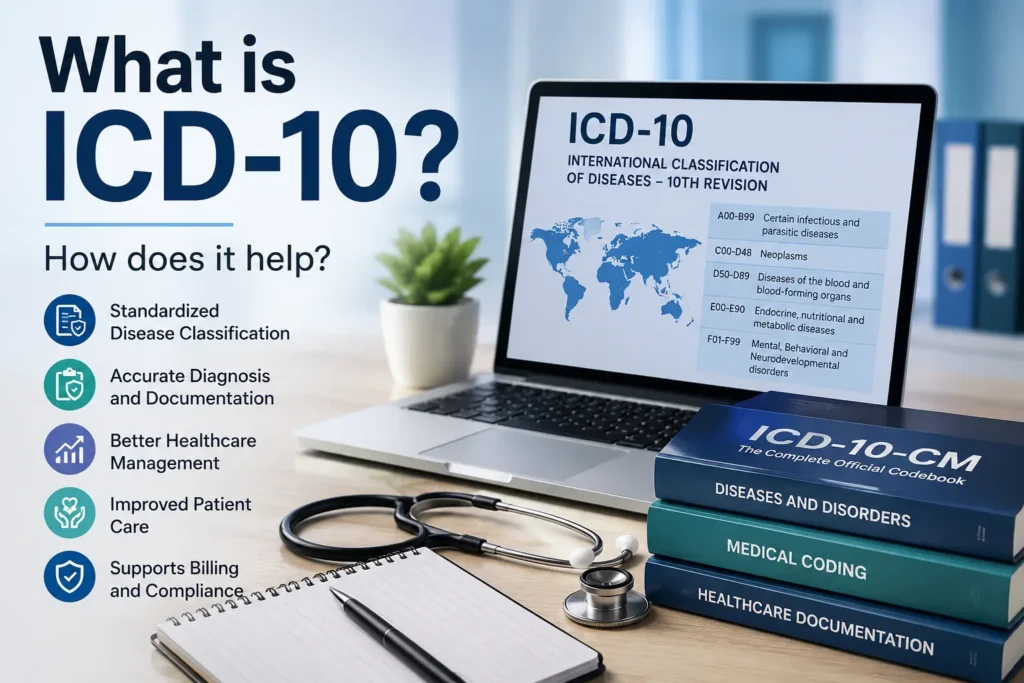
What is ICD-10? How Does It Help?

What is ICD-10? How Does It Help? What is ICD-10? How Does It Help? In today’s healthcare industry, accurate documentation and standardized communication are essential. Doctors, hospitals, insurance companies, and healthcare professionals across the world rely on a common system to record diseases and medical conditions. This system is known as the International Classification of Diseases (ICD). Among its versions, ICD-10 has become one of the most widely used coding systems, playing a vital role in diagnosis reporting, medical billing, public health monitoring, and healthcare analytics. If you are planning a career in medical coding or simply want to understand how healthcare documentation works, learning about ICD-10 is the perfect place to start. What is the International Classification of Diseases? The International Classification of Diseases (ICD) is a globally recognized coding system developed by the World Health Organization (WHO). It provides a standardized method for classifying diseases, symptoms, injuries, and health conditions. Healthcare providers use these codes to: Document patient diagnoses Maintain electronic health records Process insurance claims Track diseases and health trends Support medical research Improve healthcare management Since the same coding language is used worldwide, healthcare professionals can communicate medical information consistently and accurately. History of ICD The origins of the International Classification of Diseases date back more than a century. In the late 1800s, an international effort was made to create a uniform system for recording causes of death. Over the years, the classification system evolved to include diseases, injuries, and health conditions. The World Health Organization assumed responsibility for maintaining and updating the ICD after its establishment in 1948. Several versions have been introduced: ICD-6 (1949) ICD-7 (1955) ICD-8 (1965) ICD-9 (1975) ICD-10 (1990) ICD-11 (latest version) Each revision expanded the number of codes and improved the ability to capture detailed medical information. What is ICD-10? ICD-10 stands for the 10th Revision of the International Classification of Diseases. It was developed by the World Health Organization to provide more detailed and specific disease classification compared to ICD-9. ICD-10 contains thousands of diagnosis codes used to describe: Diseases Injuries Symptoms Medical conditions External causes of illness Factors influencing health status These codes are alphanumeric and usually consist of three to seven characters, allowing healthcare providers to document patient conditions with greater precision. For example: E11.9 – Type 2 Diabetes Mellitus without complications I10 – Essential Hypertension J45.909 – Unspecified Asthma, uncomplicated This level of detail helps ensure accurate diagnosis reporting and reimbursement. ICD-10 in the United States The United States adopted ICD-10-CM (Clinical Modification) for diagnosis coding on October 1, 2015, replacing ICD-9-CM. The U.S. version includes additional codes and clinical details specifically designed to meet healthcare documentation and reimbursement requirements. ICD-10-CM is used by: Hospitals Physician offices Clinics Insurance companies Government healthcare programs Medical coders and billers The implementation of ICD-10 significantly improved coding accuracy and allowed healthcare organizations to capture more comprehensive patient information. Why Was ICD-10 Introduced? ICD-9 had limitations due to its smaller number of codes and inability to describe modern healthcare conditions adequately. ICD-10 was introduced to: Increase coding specificity Improve patient documentation Support better reimbursement processes Enhance disease tracking Facilitate healthcare research Meet advancements in medicine and technology The expanded coding system allows healthcare professionals to record diagnoses more accurately and efficiently. How Does ICD-10 Help? 1. Improves Diagnostic Accuracy ICD-10 offers detailed codes that enable physicians and medical coders to represent diseases and conditions more precisely. Accurate diagnosis coding contributes to better treatment and patient care. 2. Supports Medical Billing and Insurance Claims Insurance companies require diagnosis codes to process claims. ICD-10 helps healthcare providers submit claims accurately, reducing delays and denials. 3. Enhances Patient Record Management Standardized coding ensures that patient information remains organized and easy to retrieve, supporting continuity of care. 4. Assists Public Health Monitoring Government agencies and healthcare organizations use ICD-10 data to track disease outbreaks, monitor population health, and develop preventive strategies. 5. Facilitates Medical Research Researchers analyze ICD-10-coded data to study disease trends, treatment outcomes, and healthcare patterns, contributing to medical advancements. Structure of ICD-10 Codes ICD-10 codes follow an alphanumeric format: First character: Alphabet Second and third characters: Numeric Additional characters: Provide greater specificity For example: M54.5 M = Diseases of the musculoskeletal system 54 = Dorsalgia category .5 = Low back pain This structure allows coders to capture detailed information about a patient’s condition. Who Uses ICD-10? Many healthcare professionals and organizations rely on ICD-10, including: Physicians Hospitals Medical coders Insurance companies Healthcare researchers Public health agencies Government organizations Without standardized diagnosis codes, maintaining consistency in healthcare documentation would be difficult. Importance of ICD-10 in Medical Coding For medical coders, ICD-10 is one of the most important coding systems to master. Understanding ICD-10 helps coders: Assign accurate diagnosis codes Improve claim approval rates Reduce billing errors Maintain compliance standards Enhance coding productivity This is why ICD-10 training is a fundamental part of medical coding courses and certification programs. Future of ICD Coding Healthcare continues to evolve, and coding systems evolve with it. The latest version, ICD-11, has already been introduced globally, offering even more advanced digital capabilities. However, ICD-10 remains widely used and continues to be the foundation of diagnosis coding in many countries, including the United States. Medical coding professionals who build a strong understanding of ICD-10 establish a solid foundation for adapting to future coding systems. Frequently Asked Questions (FAQs) What does ICD-10 stand for? ICD-10 stands for the 10th Revision of the International Classification of Diseases, a coding system used to classify diseases and health conditions. Who developed ICD-10? ICD-10 was developed by the World Health Organization (WHO) to standardize disease classification worldwide. Why is ICD-10 important? ICD-10 improves diagnostic accuracy, supports insurance claims, enhances patient record management, and assists healthcare research and disease tracking. When did the United States adopt ICD-10? The United States officially adopted ICD-10-CM on October 1, 2015. What is the difference between ICD-9 and ICD-10? ICD-10 contains significantly more codes and provides greater specificity compared to ICD-9, allowing more detailed documentation. Is ICD-10

Blog

The Global Demand for Medical Coders in 2026: Career Scope & Remote Work

The Global Demand for Medical Coders in 2026: Career Scope & Remote Work 8% Job Growth (2024–2032)  50K+ New Openings Yearly   70% Work Remotely   The healthcare industry is one of the fastest-growing sectors in the world, and behind every doctor’s visit, hospital stay, and surgical procedure is a silent but essential professional — the medical coder. As we move deeper into 2026, the demand for skilled medical coders has never been higher, and the opportunity to work remotely has made this career even more attractive across the globe. What Is Medical Coding? Medical coding is the process of translating healthcare diagnoses, procedures, medical services, and equipment into universal alphanumeric codes. These codes — drawn from systems like ICD-10-CM, CPT, and HCPCS Level II — are the foundation of medical billing. Without accurate coding, insurance claims cannot be processed, hospitals cannot receive payments, and patient records lose their clinical meaning. In simple terms, medical coders are the bridge between clinical care and financial reimbursement. They ensure that healthcare providers are paid correctly and that patient data is recorded with precision for future treatment and research. Why Is Demand Soaring in 2026? Several powerful forces are driving the surge in medical coding jobs this year and beyond:Aging global population — As more people require long-term and chronic care, the volume of medical records, insurance claims, and clinical documentation grows exponentially. Every encounter needs a code. The transition to electronic health records (EHR) systems has also accelerated demand. Hospitals, clinics, and telehealth platforms now generate massive volumes of digital data that must be coded accurately and compliantly. Additionally, the global expansion of health insurance — particularly in developing markets across South Asia and Southeast Asia — has opened new corridors of employment for trained coders. The United States Bureau of Labor Statistics projects an 8% growth rate for health information technologists through 2032 — significantly faster than the average for all occupations. India, the Gulf Cooperation Council countries, and the Philippines are all emerging as major hubs for remote medical coding talent. The Remote Work Revolution in Healthcare One of the most transformative shifts in medical coding has been the normalization of remote work. What began as a pandemic-era necessity has become a permanent feature of the profession. Today, approximately 70% of medical coders globally work from home or in hybrid arrangements. For candidates in India — particularly in cities like Faridabad, Delhi-NCR, Hyderabad, and Bengaluru — this means access to international opportunities without relocation. A certified coder in Faridabad can work for a US-based hospital system, a UK healthcare trust, or a Middle Eastern insurance company, all from their home office.Remote medical coding roles typically offer competitive salaries, flexible schedules, zero commute costs, and the ability to serve multiple clients as a freelancer or through a healthcare BPO. It is one of the few healthcare careers that combines clinical knowledge with desk-based work. Key Skills Employers Are Looking For To thrive in the 2026 medical coding market, professionals need a combination of technical knowledge and soft skills. Here is what leading healthcare employers expect: ICD-10-CM/PCS Coding CPT & HCPCS Codes HIPAA Compliance EHR Software Anatomy Knowledge CPC / CCS Certification Certification from bodies like AAPC (CPC — Certified Professional Coder) and AHIMA (CCS — Certified Coding Specialist) remains the gold standard. Employers increasingly require or prefer certified candidates, and certified coders command 15–25% higher salaries on average. Career Paths & Salary Outlook Medical coding is not a dead-end job — it is a launchpad. Entry-level coders typically begin in outpatient or physician office coding, then progress to inpatient, specialty, or auditing roles. Senior coders often transition into coding compliance, revenue cycle management, health information management, or training roles. In India, a freshly certified medical coder can expect starting salaries between ₹18,000–₹30,000 per month. With 2–3 years of experience and a specialty certification, earnings can climb to ₹50,000–₹80,000 per month. Those working directly with international clients through freelance or BPO arrangements often earn significantly more, sometimes billing in USD or GBP. Is Medical Coding Right for You? Medical coding is ideal for candidates who have completed 12th grade in science or have a background in paramedical, nursing, pharmacy, or healthcare administration. It suits detail-oriented individuals who enjoy systematic work, have an interest in healthcare, and want a career that offers stability, flexibility, and growth. With a typical training duration of 3 to 6 months, it is one of the most accessible healthcare careers to enter. The investment in training is modest compared to the long-term earning potential, especially when you factor in the remote work premium and international job access.The world needs medical coders more than ever — and 2026 is the right year to start. With the right training, the right certification, and the right guidance, a stable, well-paying, and flexible career in healthcare is well within reach. Unicode Healthcare Services Medical Coding Training Institute Empowering aspiring healthcare professionals with industry-relevant medical coding training — covering ICD-10, CPT, HCPCS, anatomy, and certification preparation. Join a community of certified coders building global careers from India.  

Blog

Best Medical Coding Course in Vijayawada

Best Medical Coding Course in Vijayawada If you are looking to build a stable and rewarding career in the healthcare industry, enrolling in the Best Medical Coding Course in Vijayawada is a smart decision. Medical coding is one of the fastest-growing healthcare professions, offering excellent job opportunities, attractive salaries, and long-term career growth. At Unicode Healthcare Services, we provide industry-focused medical coding training designed to help students succeed in today’s competitive healthcare job market. Why Choose Medical Coding as a Career? Medical coding plays a vital role in the healthcare system by converting medical diagnoses, procedures, and services into standardized codes. These codes are used for insurance claims, billing, compliance, and healthcare data management. With the rise of digital healthcare and insurance-based systems, the demand for skilled medical coders continues to increase across hospitals, clinics, and healthcare organizations. Choosing medical coding as a career offers several advantages: High demand and job security Opportunities to work in hospitals, MNCs, and healthcare BPOs Work-from-home and remote job options Global career opportunities Fast entry into the healthcare industry Why Unicode Healthcare Services is the Best Choice in Vijayawada Unicode Healthcare Services is recognized as a trusted medical coding training institute in Vijayawada, known for quality education, practical training, and strong student support. Our training programs are designed to meet current industry standards and certification requirements. Key Features of Our Medical Coding Course Comprehensive training on ICD-10-CM, CPT, and HCPCS Expert trainers with real-time industry experience Practical, case-based coding practice Certification-focused curriculum Flexible class timings (online & classroom options) Affordable course fees Dedicated placement assistance Certification-Oriented Training At Unicode Healthcare Services, our medical coding course prepares students for leading professional certifications such as: CPC (Certified Professional Coder) CCS (Certified Coding Specialist) COC (Certified Outpatient Coder) Certification enhances your credibility, improves job prospects, and helps you secure higher salary packages. Our faculty provides complete exam guidance, mock tests, and exam strategies to help students clear certification exams confidently. Who Can Join This Course? Our medical coding course in Vijayawada is ideal for: Life science graduates (BSc, MSc, Biotechnology, Microbiology, etc.) Pharmacy graduates (BPharm, DPharm, MPharm) Nursing graduates Allied health science students Fresh graduates looking to enter healthcare Professionals planning a career switch into healthcare No prior coding experience is required. We start from the basics and gradually move to advanced coding concepts. Job Opportunities After Medical Coding Training After completing training at Unicode Healthcare Services, students can apply for roles such as: Medical Coder Junior Medical Coder Coding Analyst Medical Billing Executive AR Caller Quality Analyst (with experience) Our placement support team helps students connect with top healthcare companies and MNCs hiring trained medical coding professionals. Why Vijayawada Students Trust Unicode Healthcare Services Students in Vijayawada choose Unicode Healthcare Services because of our: Proven training methodology Student-focused learning environment Regular assessments and performance tracking Resume preparation and interview training Strong industry network for placements We focus not just on training, but on building long-term healthcare careers. Start Your Medical Coding Career Today If you are searching for the Best Medical Coding Course in Vijayawada, Unicode Healthcare Services is your ideal training partner. Our expert-led training, certification support, and placement guidance make us one of the top choices for aspiring medical coders. 📞 Contact Unicode Healthcare Services today to get details on batch timings, fees, demo classes, and enrollment. Take the first step toward a successful career in medical coding!

Blog

How to Start a Career in Medical Coding Without a Medical Background

How to Start a Career in Medical Coding Without a Medical Background Many people assume that medical coding is only for doctors, nurses, or healthcare professionals. In reality, medical coding is one of the few healthcare careers you can start even without a medical background. With the right training and certification, graduates from any stream can successfully build a career in this growing field. This blog explains how you can start a medical coding career step by step—even if you have no prior medical experience—and why Unicode Healthcare Services is considered the best medical coding institute in Vijayawada. What Is Medical Coding? (In Simple Terms) Medical coding is the process of converting medical diagnoses, procedures, and services into standardized codes such as: ICD-10-CM (Diagnosis codes) CPT (Procedure codes) HCPCS Level II (Supplies & services) These codes are used for insurance billing, claim processing, patient records, and healthcare data analysis. Medical coders work behind the scenes and do not provide clinical care. Can You Become a Medical Coder Without a Medical Background? Yes, absolutely. You do not need: A medical degree Clinical experience Nursing background You only need: Basic English reading skills Willingness to learn medical terminology Good attention to detail Structured professional training Many successful medical coders come from B.Com, B.Sc, B.A, B.Tech, BCA, BBA, and even non-science backgrounds. Step-by-Step Guide to Start Medical Coding Without Medical Knowledge Step 1: Learn Medical Basics Through Training Medical coding institutes teach medical fundamentals from scratch, including: Anatomy & physiology Medical terminology Disease processes At Unicode Healthcare Services, trainers ensure even non-medical students understand concepts clearly with examples and case studies. Step 2: Enroll in a Professional Medical Coding Course Choose an institute that offers: Beginner-friendly teaching ICD-10, CPT & HCPCS coding Real-time case sheet practice Exam-oriented CPC training Unicode Healthcare Services offers structured medical coding training in Vijayawada with expert mentors and industry-aligned curriculum. Step 3: Choose the Right Certification (CPC) For beginners, the best certification is: CPC (Certified Professional Coder) – AAPC This certification is globally recognized and ideal for candidates without medical experience. Step 4: Prepare for the CPC Exam A good training institute helps with: Official coding guidelines Mock exams Time management techniques Exam strategies Unicode Healthcare Services provides full CPC exam preparation with practice tests and doubt-clearing sessions. Step 5: Gain Practical Exposure Hands-on experience is critical. Look for training that includes: Live case coding Scenario-based practice Audit and compliance basics Unicode Healthcare Services focuses on real-time coding practice, making students job-ready. Step 6: Placement Training & Interview Preparation Non-medical students often worry about interviews. Proper placement support solves this. Unicode Healthcare Services offers: Resume & LinkedIn profile support Mock HR & technical interviews Coding scenario discussions Continuous placement assistance Why Medical Coding Is a Great Career for Non-Medical Graduates ✔ High Demand Healthcare companies require coders regardless of economic conditions. ✔ No Clinical Pressure No patient interaction, no emergency work. ✔ Global Career Options Opportunities in India, US, UAE, and remote roles. ✔ Career Growth You can move into auditing, CDI, quality analysis, or management roles. Why Unicode Healthcare Services Is the Best Medical Coding Institute in Vijayawada Unicode Healthcare Services stands out because of: Beginner-friendly training approach Experienced CPC-certified trainers Complete syllabus coverage (ICD-10, CPT, HCPCS) CPC exam-oriented coaching Real-time case sheet practice Dedicated placement support Support for non-medical background students Strong industry connections Unicode has successfully trained students from non-medical and non-science backgrounds, helping them build successful medical coding careers. Career Roles After Medical Coding After certification, you can work as: Medical Coder Junior Coding Analyst RCM Executive Coding Quality Analyst Denial Management Executive Salary Range India: ₹3.5 – ₹8 LPA International: Higher packages with experience Conclusion Starting a career in medical coding without a medical background is not only possible—it’s common. With structured training, certification, and placement support, anyone can enter this rewarding healthcare field. If you’re searching for the best medical coding institute in Vijayawada, Unicode Healthcare Services provides expert training, CPC preparation, and career-focused guidance to help you succeed confidently.

Blog

Step-by-Step Process to Become a Certified Medical Coder

Step-by-Step Process to Become a Certified Medical Coder Step-by-Step Process to Become a Certified Medical Coder Medical coding has become one of the most stable and in-demand career options in the healthcare industry. With hospitals, insurance companies, and healthcare IT firms expanding globally, the need for certified medical coders is growing rapidly. If you are planning to start a career in this field, following the right step-by-step process is essential. This blog explains the complete journey—from understanding medical coding to getting certified and placed successfully. Step 1: Understand What Medical Coding Is Medical coding is the process of converting medical diagnoses, procedures, and healthcare services into standardized codes such as: ICD-10-CM – Diagnosis coding CPT – Procedure coding HCPCS Level II – Supplies and non-physician services These codes are used for billing, insurance claims, medical records, and healthcare analytics. A medical coder ensures accuracy, compliance, and proper reimbursement. Step 2: Check Eligibility Requirements The good news is that medical coding does not require a medical degree. Basic Eligibility: Any graduate (science, commerce, arts) Life science background is an advantage Basic computer knowledge Good English reading and comprehension skills Both freshers and working professionals can enter medical coding with the right training. Step 3: Choose the Right Medical Coding Course Selecting a structured training program is one of the most important steps. A good medical coding course should include: Anatomy & physiology Medical terminology ICD-10-CM guidelines CPT & HCPCS coding Real-time case sheet practice Compliance and audit basics Institutes like Unicode Healthcare Services in Bangalore and Hyderabad provide industry-aligned training with expert mentors and real-time practice. Step 4: Decide on the Right Certification Certification validates your skills and improves job opportunities. The most popular certifications include: Entry-Level Certification CPC (Certified Professional Coder) – Best for beginners Advanced/Specialty Certifications COC – Outpatient hospital coding CIC – Inpatient hospital coding CRC – Risk adjustment coding CCS – Advanced inpatient & outpatient coding Most beginners start with CPC and specialize later based on experience. Step 5: Prepare for the Certification Exam Proper exam preparation increases your chances of clearing the certification in the first attempt. Preparation Tips: Study official ICD-10, CPT, and HCPCS manuals Practice real medical case scenarios Take mock exams regularly Understand guidelines instead of memorizing codes Improve time management Professional training institutes provide mock tests, exam strategies, and doubt-clearing sessions. Step 6: Appear for the Certification Exam Once you feel confident, register for the certification exam through the official body (AAPC or AHIMA). Exam Format (CPC Example): 100 multiple-choice questions 4 hours duration Open book (coding manuals allowed) Passing the exam officially makes you a Certified Medical Coder. Step 7: Gain Practical Experience After certification, hands-on experience is crucial. You can gain experience through: Internship programs Live project training Entry-level coding roles RCM or billing departments Real-time exposure improves accuracy and builds confidence. Step 8: Prepare for Interviews & Placement To secure a job quickly, you need interview-ready skills. Key Focus Areas: Coding guidelines knowledge Case-based questions Compliance scenarios Communication skills Resume and LinkedIn optimization Institutes like Unicode Healthcare Services offer placement training, mock interviews, and continuous job support. Step 9: Apply for Medical Coding Jobs Certified medical coders can work in: Hospitals Medical billing companies RCM firms Insurance companies Healthcare IT organizations Common Job Roles: Medical Coder Junior/Senior Coder Coding Analyst RCM Executive Denial Management Specialist Step 10: Upskill and Grow Your Career Medical coding is a continuous learning profession. To grow faster: Specialize in inpatient, DRG, or risk adjustment coding Learn CDI and auditing basics Stay updated with yearly coding changes Explore AI-assisted coding tools Advanced certifications lead to higher salaries and global opportunities. Career Scope & Salary India: ₹4–10 LPA International (US, UAE): Higher packages based on experience High demand and job stability Opportunity to work remotely Conclusion Becoming a certified medical coder is a structured and achievable goal if you follow the right steps. From choosing proper training and certification to gaining experience and placement support, each step plays a critical role in building a successful healthcare career. If you’re looking for expert-guided training, certification preparation, and placement assistance, Unicode Healthcare Services in Bangalore and Hyderabad offers industry-focused programs designed to help you succeed confidently in medical coding.

🎯 Admissions Open for 2026 Batch   |   💼 100% Placement Assistance   |   📞 Call Now:+91-7022469777—  For  Medical Coding & CPC Certifications  | Medical Coding New Batch Start  From 1st SEP

Contact Us


Scroll to Top