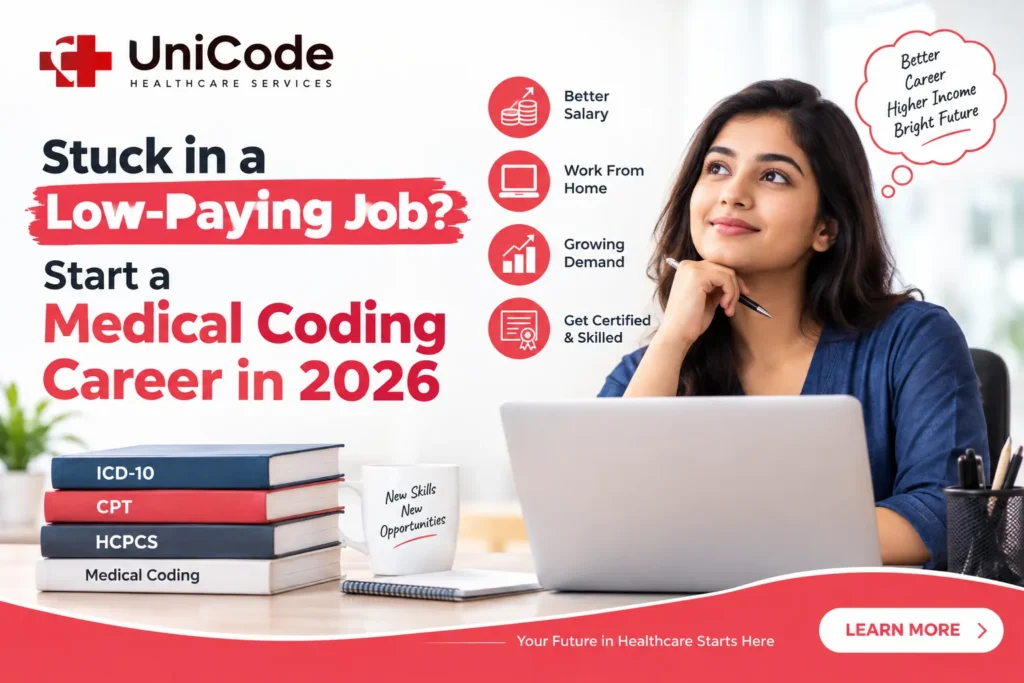
Stuck in a Low-Paying Job? Start a Medical Coding Career in 2026
Stuck in a Low-Paying Job? Start a Medical Coding Career in 2026 Are you working hard every day but still feel like your salary and career growth have reached a dead end? You are not alone. Many graduates and working professionals want to move into a better career but hesitate because changing industries can feel risky. If you already have a background in life sciences, healthcare, pharmacy, biotechnology, or a related field, there may be a career path worth exploring without spending years going back to college. Medical coding is one such option. As healthcare organizations continue to depend on accurate clinical documentation, coding, billing, claims, and revenue-cycle processes, trained professionals are needed to handle these responsibilities. For the right candidate, medical coding can become a practical entry point into the healthcare industry. But before you leave your current job or join a course, it is important to understand what the career actually involves and how you can prepare for it. What Is Medical Coding? Medical coding is the process of converting information from medical documentation into standardized codes. When a patient visits a hospital, clinic, or healthcare provider, the medical record can contain diagnoses, symptoms, procedures, treatments, and other clinical information. A medical coder reviews this documentation and assigns appropriate codes according to established coding systems and guidelines. Some of the major coding systems include: ICD-10-CM for diagnosis coding CPT for many medical procedures and professional services HCPCS Level II for various healthcare services, supplies, and products Medical coding plays an important role in healthcare administration, claims processing, reporting, and reimbursement. Why Are Professionals Moving Toward Medical Coding? A low salary isn’t always the only reason someone considers a career change. Sometimes the real problem is a lack of growth, learning, stability, or a clear career path. Medical coding attracts people from different educational and professional backgrounds because it combines healthcare knowledge with analytical and documentation-based work. For graduates who don’t want a clinical career, it can provide another way to work within the healthcare industry. However, medical coding isn’t a shortcut to instant success. Like any professional career, it requires training, practice, accuracy, and continuous learning. Who Can Consider a Career in Medical Coding? Medical coding can be particularly interesting for graduates with backgrounds in: Life Sciences Biotechnology Microbiology Biochemistry Pharmacy Nursing Allied healthcare Other healthcare-related disciplines Graduates from other backgrounds may also explore the field, but they may need to spend additional time building their medical knowledge. If you already understand basic biology, anatomy, physiology, or medical terminology, you may have a useful foundation to build upon. What Does a Medical Coder Actually Do? A medical coder’s day isn’t simply about looking up codes. Depending on the role, responsibilities may include: Reviewing medical records Understanding provider documentation Identifying diagnoses and procedures Applying coding guidelines Assigning appropriate codes Checking documentation for accuracy Reviewing coding-related issues Maintaining coding quality Working with quality or auditing teams The ability to understand the documentation behind a code is one of the most important skills for a successful coder. Skills You Need to Build in 2026 If you’re serious about moving into medical coding, don’t focus only on memorizing codes. Build a strong foundation. 1. Medical Terminology You should be comfortable with common medical terms, abbreviations, diseases, procedures, and clinical language. 2. Anatomy and Physiology Understanding the human body helps you interpret medical documentation more effectively. 3. ICD-10-CM You need to understand how diagnosis codes are structured and how coding guidelines influence code selection. 4. CPT Knowledge of CPT is important for understanding how many procedures and professional services are reported. 5. HCPCS HCPCS Level II covers various services, supplies, and healthcare products. 6. Coding Guidelines Knowing the rules behind coding decisions is more valuable than simply memorizing codes. 7. Attention to Detail A small documentation detail can change a coding decision. Accuracy is therefore extremely important. 8. Analytical Thinking Medical records aren’t always straightforward. You need to understand the documentation and determine how the applicable guidelines should be applied. 9. Communication Skills Medical coders work as part of larger healthcare teams, so clear communication is useful for professional growth. Is Certification Important for Medical Coders? Certification can demonstrate your knowledge and commitment to the profession. One certification that many aspiring professional coders consider is the CPC (Certified Professional Coder) credential. Depending on your career goals, there are also other professional certifications related to areas such as: Inpatient coding Risk adjustment coding Specialty coding Professional coding Healthcare coding and compliance The right certification depends on the type of coding career you want to pursue. If you’re searching for CPC certification in Bangalore, don’t look only at the certification exam itself. Pay attention to the quality of preparation, practical coding exercises, trainer support, and your understanding of the underlying concepts. Why Practical Training Matters Imagine learning to drive by reading a driving manual but never sitting behind the wheel. You may know the rules, but applying them in real situations is different. Medical coding works in a similar way. You can memorize ICD-10-CM codes, CPT concepts, and medical terminology, but real medical records can contain complex documentation. That is why practical training should include: Sample medical records Case-based exercises Coding practice ICD-10-CM exercises CPT practice HCPCS concepts Coding guideline application Mock assessments Interview preparation When comparing best medical coding courses in Bangalore, look at the practical component rather than choosing a program simply because it has a short duration. How to Choose the Best Medical Coding Institute in Bangalore Bangalore has a large healthcare and technology ecosystem, making it an attractive location for people exploring healthcare-related careers. But choosing the right institute requires some research. When comparing the best medical coding institutes in Bangalore, ask: What topics are covered? Is the curriculum updated? Are medical terminology and anatomy included? Does the training cover ICD-10-CM, CPT, and HCPCS? Are practical case studies provided? Are trainers experienced? Is certification preparation included? Is interview preparation provided? Is career guidance available? Can students ask questions and receive