Best Medical Coding Training Institute in Bangalore & Hyderabad

Medical coding jobs in Hyderabad

medical coding vs medical billing
Blog

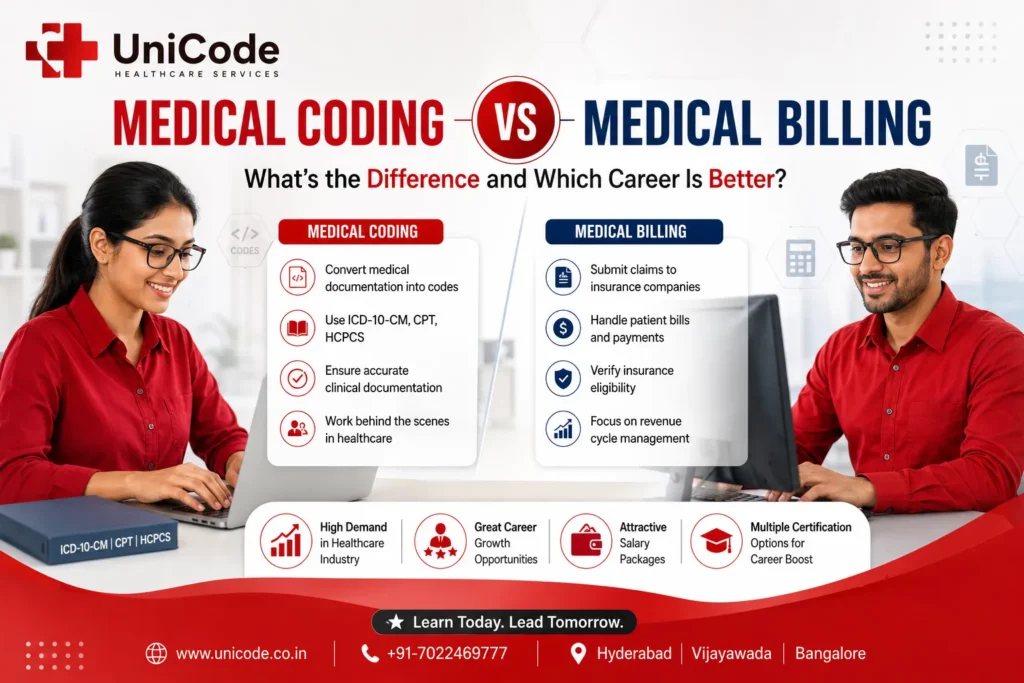
Medical Coding vs Medical Billing: What’s the Difference and Which Career Is Better?

Medical Coding vs Medical Billing: What’s the Difference and Which Career Is Better? Medical coding and medical billing are often treated as the same career—but they are not. Both are important parts of the healthcare revenue cycle, and both offer career opportunities for graduates who want to work in the healthcare industry without entering a clinical profession. But what exactly does a medical coder do? What does a medical biller do? Which one requires more medical knowledge? Which career is better for freshers? And should you choose coding, billing, or learn both? If you’re considering a healthcare career, understanding these differences before joining a course can save you from making the wrong choice. What Is Medical Coding? Medical coding is the process of converting information from a patient’s medical records into standardized medical codes. A medical record can contain diagnoses, symptoms, procedures, treatments, and other clinical information. The coder reviews this documentation and assigns the appropriate codes according to established coding guidelines. Some of the major coding systems include: ICD-10-CM – mainly used for diagnosis coding CPT – used for reporting medical procedures and professional services HCPCS Level II – used for various healthcare services, supplies, and products A medical coder needs to understand medical terminology, anatomy and physiology, documentation, and coding guidelines. The job is not simply about finding a code in a book or software. A good coder needs to understand the clinical information and determine which code accurately represents the documented condition or service. What Is Medical Billing? Medical billing is more closely connected to the financial side of healthcare. Once medical services have been documented and coded, billing professionals work with that information to prepare and submit claims to insurance companies or other payers. A medical biller’s responsibilities may include: Preparing healthcare claims Submitting claims to insurance companies Checking claim status Identifying rejected or denied claims Following up on unpaid claims Reviewing payment information Maintaining billing records Communicating with insurance companies and healthcare organizations In simple terms, medical coding translates healthcare documentation into codes, while medical billing uses that coded information as part of the reimbursement process. Medical Coding vs Medical Billing: The Key Difference The easiest way to understand the difference is to look at their primary responsibilities. Medical Coding Medical Billing Reviews medical documentation Works with claims and payments Assigns diagnosis and procedure codes Prepares and submits claims Requires strong medical terminology knowledge Requires understanding of billing processes Focuses on coding accuracy Focuses on reimbursement and claim processing Uses ICD-10-CM, CPT, HCPCS Works with coded information and payer requirements More closely connected to clinical documentation More closely connected to financial processes Although the two functions are different, they work together. An incorrect code can affect a claim, and an error during billing can delay reimbursement. This is why healthcare organizations need professionals who understand their responsibilities clearly. Which Career Is Better for Freshers? There isn’t one answer that applies to everyone. The better career depends on your interest, educational background, strengths, and long-term goals. If you enjoy medical terminology, anatomy, diseases, procedures, and analyzing medical records, medical coding may be a better fit. If you are more interested in claims, insurance processes, payments, documentation, and administrative work, medical billing may suit you better. And there is another option: Learn both. Having knowledge of medical coding and billing can help you understand the complete healthcare revenue cycle and may open the door to a wider range of entry-level roles. Medical Coding May Be a Good Choice for Life Science Graduates Students from B.Sc. and other life science backgrounds often already have exposure to subjects such as biology, anatomy, physiology, or related areas. That background can make it easier to understand medical terminology and clinical documentation. However, academic knowledge alone isn’t enough. A student still needs proper training in ICD-10-CM, CPT, HCPCS, coding guidelines, medical terminology, and practical coding scenarios. This is why many graduates search for best medical coding courses in Hyderabad when planning their transition into healthcare operations. What Skills Are Needed for Medical Coding? Medical coding requires a combination of healthcare knowledge and analytical ability. Medical Terminology You should understand common medical terms, abbreviations, diseases, procedures, and clinical language. Anatomy and Physiology A basic understanding of the human body helps you interpret medical documentation correctly. Coding Guidelines Knowing ICD-10-CM, CPT, and HCPCS is important, but understanding the rules behind code selection is even more important. Attention to Detail Medical records can contain a lot of information. One small detail can influence code selection, so careful reading is essential. Analytical Thinking Coders often need to interpret documentation and apply coding guidelines rather than simply match keywords. Communication Skills Clear communication can help when working with colleagues, quality teams, auditors, and other healthcare professionals. What Skills Are Needed for Medical Billing? Medical billing requires a somewhat different skill set. A medical billing professional should develop an understanding of: Healthcare claims Insurance processes Billing terminology Claim submission Payment posting Denial management Accounts receivable Follow-up procedures Basic medical terminology Communication and documentation Strong organizational skills can also be valuable because billing involves tracking claims, payments, and follow-ups. Medical Coding Certification vs Medical Billing Training Another important difference is the certification path. Medical coding professionals may choose certifications such as CPC, CCS, CIC, or CRC, depending on their career goals and specialization. For someone starting in coding, CPC certification is one commonly considered professional credential. Medical billing, on the other hand, is often entered through job-oriented training that focuses on billing processes, insurance claims, revenue cycle management, and related workflows. If you’re not sure which path to choose, learning the fundamentals of both medical coding and medical billing can help you understand which area suits you better. Choosing Medical Coding Training in Hyderabad Hyderabad has become a popular destination for students interested in healthcare-related careers. But choosing a training institute shouldn’t be based only on advertisements or promises. Before joining a course, look at the actual learning experience. Ask: Does the course cover ICD-10-CM? Is CPT included?
Medical Coding Career 2026
Blog

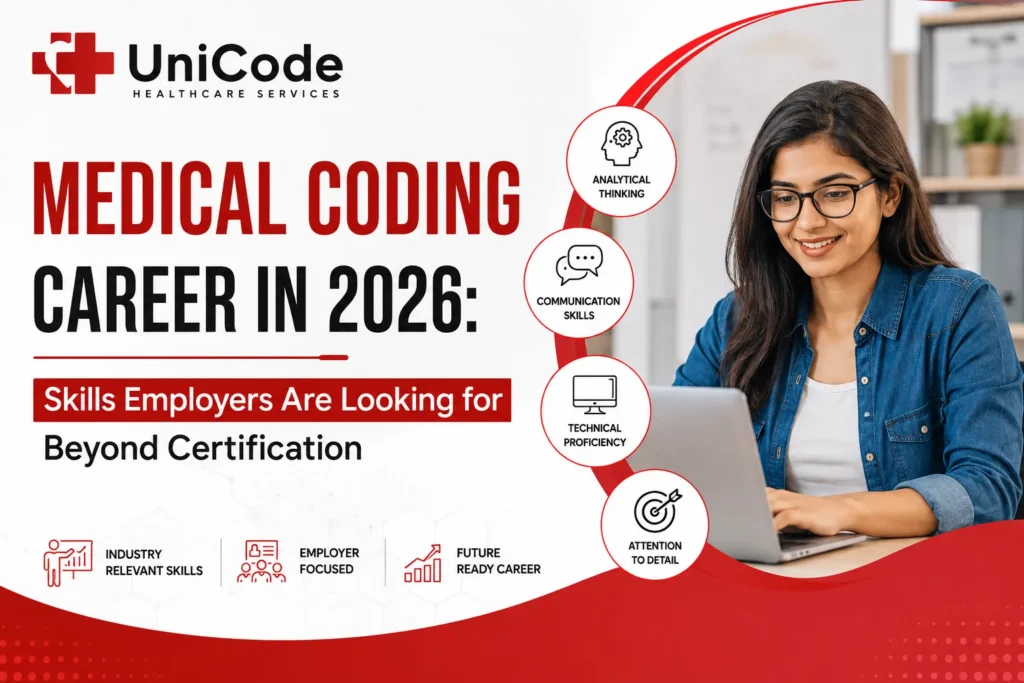
Medical Coding Career in 2026: Skills Employers Are Looking for Beyond Certification

Medical Coding Career in 2026: Skills Employers Are Looking for Beyond Certification Getting certified can open the door to a medical coding career. But in 2026, certification alone may not be enough to help you walk through that door. Think about it: two candidates can have the same CPC or other coding certification. One knows how to apply coding guidelines to real-world documentation, communicate clearly, work with EHR systems, identify documentation gaps, and maintain accuracy under productivity expectations. The other knows the theory but struggles when faced with an actual chart. Who is more likely to stand out? The answer is clear: the coder who can turn knowledge into practical results. As healthcare organizations continue to focus on coding accuracy, compliance, documentation quality, and efficient revenue-cycle operations, employers are increasingly interested in practical, job-ready skills—not just certificates. 1. Strong Knowledge of ICD-10-CM, CPT and HCPCS Certification gives you a foundation, but professional coding requires you to apply that knowledge correctly. A job-ready medical coder should be comfortable working with: ICD-10-CM diagnosis coding CPT procedure coding HCPCS Level II Medical terminology Anatomy and physiology Official coding guidelines Documentation requirements E/M coding concepts The goal is not simply to memorize codes. A good coder understands why a particular code is appropriate based on the documentation. That difference becomes extremely important when dealing with complex or incomplete medical records. 2. Real-World Chart Review Skills One of the biggest gaps between classroom learning and employment is practical experience. During training, you may work with clean examples where the diagnosis and procedure are easy to identify. Real medical records can be very different. You may encounter: Multiple diagnoses Conflicting documentation Missing information Abbreviations Complex procedures Multiple comorbidities Incomplete physician notes A professional medical coder needs to read the entire documentation, understand the clinical story, identify relevant information, and then select codes according to the applicable guidelines. That is why hands-on practice can make a major difference for freshers. Even AAPC’s job-ready approach emphasizes practical experience as a bridge between certification and employment. 3. Medical Terminology and Anatomy Matter More Than You Think You cannot code what you do not understand. A strong understanding of anatomy, physiology, pathology, and medical terminology helps coders interpret provider documentation more accurately. For example, understanding the difference between a tendon, ligament, nerve, artery, and vein can make it easier to understand surgical documentation and select the appropriate code. This is especially important when moving into specialty areas such as: Surgery coding Emergency department coding Inpatient coding Home health coding Radiology coding Cardiology coding Risk adjustment coding The stronger your clinical foundation, the easier it becomes to understand complicated documentation. 4. EHR and Healthcare Technology Skills Medical coding is no longer just about code books and spreadsheets. Modern healthcare organizations rely heavily on electronic health records and other digital systems. Employers therefore value candidates who can comfortably navigate electronic documentation and healthcare technology. You should understand how to: Navigate an EHR Locate relevant clinical documentation Review physician notes Identify supporting documentation Work with electronic coding tools Search coding references efficiently Maintain accuracy while working digitally Technology knowledge can become a real advantage when several candidates have similar certifications. 5. Accuracy and Attention to Detail Medical coding is a detail-oriented profession. A small documentation difference can change the appropriate code, modifier, sequencing, or reimbursement outcome. Employers want coders who do not simply work quickly—they work accurately and consistently. Attention to detail becomes especially important when reviewing: Laterality Encounter information Anatomical locations Procedure details Diagnosis specificity Modifiers Documentation requirements Code sequencing Industry job-posting data also highlights detail orientation and research among commonly requested skills for medical billing and coding roles. 6. Communication Skills Medical coding may look like an individual computer-based job, but communication still matters. Coders may need to communicate with: Physicians Clinical teams Coding supervisors Auditors Billing teams Quality teams Revenue-cycle professionals Sometimes the documentation does not provide enough information to support a coding decision. In such situations, a coder must know how to communicate professionally and follow the appropriate query process. Good communication is not about using complicated words. It is about being clear, professional, specific, and respectful. Communication is also one of the most frequently identified common skills in medical billing and coding job-posting data. 7. Research and Problem-Solving Ability A strong coder does not guess. When a case is unfamiliar, the right approach is to research the documentation, review the applicable guidelines, verify the code, and make a supported decision. This is where analytical thinking becomes extremely valuable. Instead of asking: “What code do I remember?” A professional coder asks: “What does the documentation support, and what do the official guidelines require?” That mindset can help reduce coding errors and improve consistency. 8. Compliance Awareness Coding accuracy and compliance go hand in hand. Medical coders work with sensitive healthcare information and must understand the importance of accurate, ethical, and guideline-based coding. A good coder should develop awareness of: Coding compliance Documentation integrity Privacy and confidentiality Appropriate code assignment Audit requirements Fraud and abuse risks Organizational coding policies Certification is valuable, but employers also need people who understand the responsibility that comes with handling healthcare documentation. 9. Productivity Without Sacrificing Quality In a professional coding environment, productivity matters. But speed should never come at the expense of accuracy. The real skill is learning how to create a workflow that allows you to work efficiently while maintaining coding quality. With experience, coders learn how to: Organize their work Navigate records faster Use coding tools effectively Identify relevant documentation quickly Research efficiently Avoid repetitive mistakes The objective is smart productivity, not simply rushing through charts. 10. Ability to Work With AI and Coding Technology AI is becoming an important part of healthcare technology, including medical coding. But the rise of AI does not eliminate the need for knowledgeable coders. Instead, it makes human judgment, validation, documentation interpretation, and compliance awareness even more important. Recent research continues to explore AI-assisted medical coding, while also highlighting the complexity of accurately mapping clinical

🎯 Admissions Open for 2026 Batch   |   💼 100% Placement Assistance   |   📞 Call Now:+91-7022469777—  For  Medical Coding & CPC Certifications  | Medical Coding New Batch Start  From 1st SEP

Contact Us


Scroll to Top