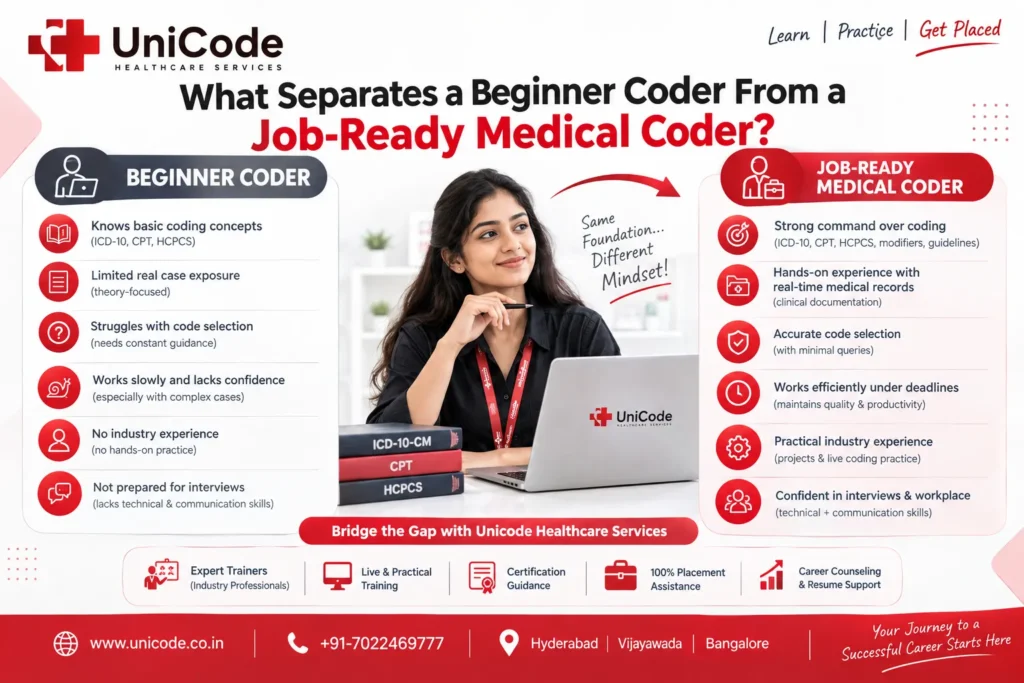
What Separates a Beginner Coder From a Job-Ready Medical Coder?
What Separates a Beginner Coder From a Job-Ready Medical Coder? You can complete a medical coding course, learn ICD-10-CM, memorize CPT codes, and even earn a certification—but does that automatically make you job-ready? Not always. There is a big difference between knowing medical coding concepts and being able to apply those concepts confidently to real medical records. A beginner may know what a diagnosis code is, while a job-ready coder understands how to read documentation, identify the relevant information, apply coding guidelines, and choose the appropriate code with accuracy. That difference is what employers notice. If you are planning to enter the healthcare industry, understanding what makes a coder truly job-ready can help you prepare for your first interview and your first day at work. What Does a Beginner Medical Coder Usually Know? A beginner generally starts by learning the fundamentals of medical coding. This includes subjects such as: Medical terminology Human anatomy and physiology ICD-10-CM coding CPT coding HCPCS Level II Basic coding guidelines Medical documentation Diagnosis and procedure concepts Introduction to medical billing These fundamentals are important because they create the foundation for a medical coding career. However, knowing definitions from a textbook is only the first step. For example, a beginner may know that ICD-10-CM is used for diagnosis coding. A job-ready coder needs to understand how the diagnosis is documented, whether the documentation supports a particular code, whether additional information is required, and which coding guidelines apply. That practical difference matters. 1. A Job-Ready Coder Can Read Medical Records One of the most important skills for a medical coder is the ability to understand clinical documentation. Medical records can contain a lot of information—patient history, symptoms, diagnoses, examination findings, procedures, medications, test results, and treatment plans. A job-ready coder knows how to separate relevant information from unnecessary details. They can identify: Why the patient was seen What condition was diagnosed What services were performed Relevant clinical details Supporting documentation Information needed for accurate code selection This skill develops through practice. Reading actual or realistic coding cases is very different from simply studying coding definitions. 2. They Don’t Guess When Documentation Is Unclear This is one of the biggest differences between a beginner and an experienced or job-ready coder. A beginner may feel pressured to select a code quickly, even when the documentation is incomplete. A professional coder understands that accuracy comes before guessing. If the medical record does not provide enough information to support a specific code, the coder should follow the applicable guidelines and organizational procedures rather than simply assuming what the provider meant. This mindset helps prevent coding errors and supports better documentation and compliance. 3. They Understand Coding Guidelines Instead of Just Memorizing Codes Medical coding isn’t a memory competition. There are thousands of codes, and trying to memorize everything is neither practical nor necessary. A job-ready coder understands how to find, verify, and apply coding information. They become comfortable working with: ICD-10-CM guidelines CPT guidelines HCPCS guidelines Codebook instructions Includes and Excludes notes Laterality Combination codes Code-first and use-additional-code instructions Applicable modifiers Documentation requirements The ability to research a code properly is often more valuable than simply remembering a long list of codes. 4. They Develop Strong Medical Terminology Skills Imagine coming across a medical record containing unfamiliar terminology. A beginner might stop at every unfamiliar word. A job-ready coder has enough medical terminology knowledge to understand the context and recognize important terms related to diseases, procedures, body systems, and treatments. Strong terminology skills make the entire coding process faster and more accurate. That’s why medical terminology should not be treated as a subject that you study once and forget. It becomes part of your everyday coding work. 5. They Understand Anatomy and Physiology Medical coding becomes much easier when you understand how the human body works. For example, if you understand the relationship between organs, body systems, diseases, and procedures, clinical documentation becomes easier to interpret. A job-ready coder doesn’t necessarily need to think like a doctor, but they need a strong enough foundation in anatomy and physiology to understand what they are coding. This is particularly important when working with complex specialties and procedures. 6. They Can Apply Knowledge to Real Cases This is where training becomes extremely important. You can spend hours reading about ICD-10-CM and CPT, but your confidence changes when you start working through actual coding scenarios. A job-ready coder should regularly practice cases involving: Outpatient visits Common diagnoses Surgical procedures E/M services Injuries Chronic conditions Laboratory and diagnostic services Specialty-specific documentation Case-based learning teaches you how to think through a record rather than simply search for a keyword. 7. They Pay Attention to Small Details Medical coding requires concentration. A small detail in a medical record can change the code selection. Things such as: Laterality Acute vs. chronic condition Initial vs. subsequent encounter Specific anatomical location Type of procedure Complications Documentation requirements can make a significant difference. A job-ready coder develops the habit of checking the details instead of rushing through the record. Accuracy is not just about knowing more codes. It’s also about developing the discipline to review documentation carefully. 8. They Know How to Handle Modifiers and Coding Situations As coders move beyond the basics, they encounter situations where simply selecting a diagnosis or procedure code isn’t enough. They may need to understand the appropriate use of modifiers and how different services are reported. For example, modifiers such as 25 and 59 can be important in appropriate circumstances, but they should never be applied simply because a coder wants to increase reimbursement. A job-ready coder understands that modifiers must be supported by documentation and applicable coding rules. 9. They Know That Certification Is Only One Part of Career Preparation Certifications such as CPC can be valuable for people entering the medical coding field. However, passing an examination and performing well in a workplace are two different experiences. Certification can demonstrate knowledge of coding concepts, while practical training helps develop the ability to apply