Best Medical Coding Training Institute in Bangalore & Hyderabad

October 2026

CPC certification course in Bangalore
Medical Coding

What Is Medical Coding? Meaning, Examples, and Career Opportunities in Bangalore

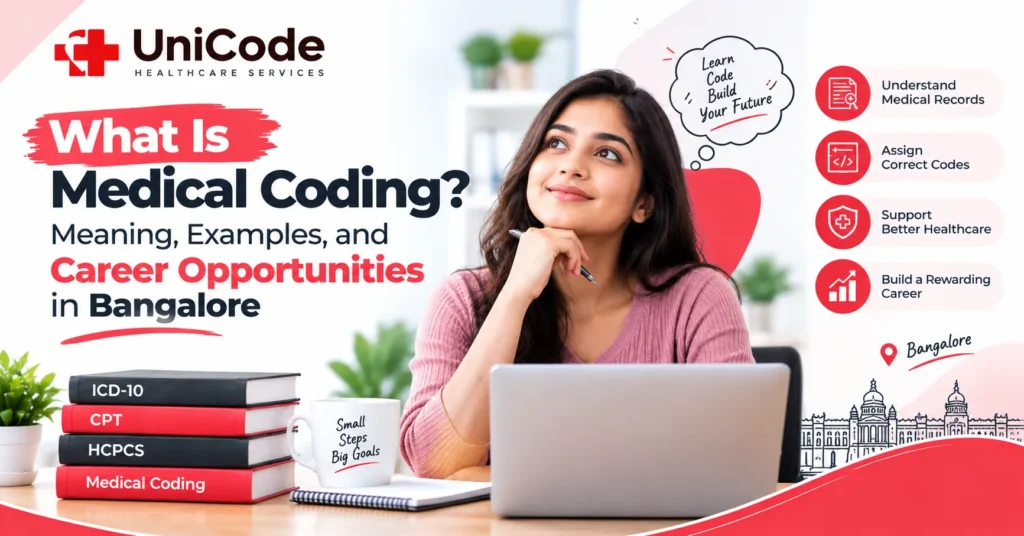
What Is Medical Coding? Meaning, Examples, and Career Opportunities in Bangalore Have you ever wondered how a doctor’s diagnosis becomes a code on a hospital bill or an insurance claim? Behind that simple-looking code is an important process that helps hospitals, healthcare providers, and insurance companies communicate accurately. This process is known as medical coding, and it has become an interesting career option for graduates who want to work in the healthcare industry without treating patients directly. Bangalore, with its hospitals, healthcare service providers, medical billing companies, and healthcare technology businesses, offers opportunities for people interested in this field. Whether you are a life science graduate, a pharmacy student, a nursing graduate, or someone planning a career change, understanding medical coding can help you decide whether this profession suits your goals. At Unicode Healthcare Services, aspiring medical coders can explore professional training to understand medical terminology, anatomy, coding guidelines, and certification preparation. Before choosing a course, however, let us understand what medical coding actually involves and how you can build a career in this field. What Is Medical Coding? Medical coding is the process of converting information from medical records into standardised alphanumeric codes. These records may include a patient’s diagnosis, symptoms, medical procedures, laboratory findings, and treatment details. Doctors and other healthcare professionals document patient care in medical records. Medical coders review that documentation and assign the appropriate codes according to established coding guidelines. These codes help healthcare organisations maintain consistent records, process insurance claims, support billing, and analyse healthcare information. For example, a doctor may document that a patient has been diagnosed with type 2 diabetes. A medical coder reviews the documentation, checks the applicable coding guidelines, and assigns the appropriate ICD-10-CM code. The coder does not diagnose the patient or independently decide which treatment is required. The role is to translate documented medical information into the correct codes while following established rules. In simple words, medical coding connects clinical documentation with the administrative and financial processes of healthcare. Why Is Medical Coding Important in Healthcare? Medical coding is more than entering numbers into a computer. Accurate coding supports several essential healthcare activities. 1. Accurate Medical Billing Hospitals and healthcare providers use coded information as part of their billing processes. Correct codes help communicate the services provided and the conditions treated. 2. Insurance Claim Processing Insurance companies use medical codes when reviewing claims. Coding errors, missing information, or unsupported codes may lead to claim rejections, delays, or requests for additional documentation. 3. Maintaining Patient Records Standardised codes help healthcare organisations organise and retrieve information about diagnoses, procedures, and patient care. 4. Healthcare Research and Reporting Coded data can be used to study disease patterns, understand healthcare utilisation, and support public health reporting. 5. Compliance With Coding Guidelines Medical coders must follow applicable coding standards and documentation requirements. Correct coding helps healthcare organisations maintain accurate records and reduce compliance risks. These responsibilities make attention to detail, medical knowledge, and a willingness to keep learning important qualities for anyone entering this profession. Medical Coding Examples: How Does It Work? The easiest way to understand medical coding is to look at a few examples. Example 1: Type 2 Diabetes Imagine that a patient visits a hospital for diabetes management. After examining the patient, the doctor documents a diagnosis of type 2 diabetes mellitus. The medical coder reviews the medical record and identifies the appropriate diagnosis code based on the documented condition and applicable guidelines. For example, ICD-10-CM code E11.9 represents type 2 diabetes mellitus without complications, when the documentation supports that classification. If the patient has documented complications, a different, more specific code may be required. Example 2: A Common Cold A patient visits a healthcare provider with symptoms of a common cold. The doctor documents the diagnosis as an acute nasopharyngitis. The medical coder reviews the documentation and may assign ICD-10-CM code J00, which represents acute nasopharyngitis [common cold]. The code must match the diagnosis recorded in the medical documentation. Example 3: A Surgical Procedure Suppose a patient undergoes a surgical procedure in a hospital. The coder reviews the operative report, identifies the procedure performed, and applies the appropriate coding system and guidelines. Depending on the healthcare setting and purpose, the coder may work with procedure coding systems such as CPT or ICD-10-PCS. These examples illustrate why medical coders need to understand medical terminology, anatomy, diseases, procedures, and coding rules instead of simply memorising codes. Note: These are educational examples. Actual code selection depends on the complete medical documentation, applicable guidelines, code-set version, and healthcare setting. What Are the Main Medical Coding Systems? Medical coding professionals work with different coding systems depending on the type of information being coded and the healthcare setting. ICD-10-CM ICD-10-CM is used in the United States to classify diagnoses and health conditions. Medical coders use it to report diseases, symptoms, and other documented conditions. CPT Current Procedural Terminology (CPT) codes describe many medical procedures and professional services. These codes are commonly used in US outpatient and professional healthcare billing. HCPCS Level II HCPCS Level II codes are used to identify certain products, supplies, equipment, and services that may not be described by CPT codes. ICD-10-PCS ICD-10-PCS is used for reporting inpatient hospital procedures in the United States. A student who understands how these systems differ can develop a stronger foundation for working with medical records and preparing for relevant certification examinations. Who Can Build a Career in Medical Coding? One reason medical coding attracts graduates from different educational backgrounds is that it combines healthcare knowledge with structured, detail-oriented work. Depending on the employer’s requirements, suitable candidates may include: B.Pharm and M.Pharm graduates B.Sc. and M.Sc. life science graduates Nursing graduates Graduates in biotechnology, microbiology, and related subjects Other candidates who meet the relevant employer and training eligibility requirements A healthcare-related educational background can be helpful because students may already understand basic medical terminology, human anatomy, physiology, or disease processes. However, every employer has its own eligibility criteria. Completing a course does not automatically guarantee

Medical coding institute in Bangalore
Medical Coding

Why Medical Coding Is an Excellent Career for Life Science Graduates

Why Medical Coding Is an Excellent Career for Life Science Graduates Are you a life science graduate looking for a career that offers professional growth, opportunities in the healthcare industry, and a chance to use your academic knowledge in a different way? Have you completed B.Sc, M.Sc, Biotechnology, Microbiology, Zoology, Botany, or another life science degree but are still exploring the right career path? You are not alone. Many life science graduates enjoy studying the human body, diseases, medicines, and healthcare but are unsure how to turn that knowledge into a rewarding profession outside traditional laboratory or research roles. Medical coding is one career option worth exploring. With the right training, graduates can learn how to translate medical documentation into standardized codes used in healthcare administration, insurance claims, billing, and reimbursement. If you are searching for medical coding training in Bangalore, this field may offer an opportunity to combine your science background with practical healthcare skills. At Unicode Healthcare Services, aspiring medical coders can explore professional training in medical coding and prepare to work toward recognized certifications such as CPC. Let us understand why medical coding is attracting life science graduates, which skills matter, and how you can get started. What Is Medical Coding? Medical coding is the process of converting information from healthcare documentation into standardized alphanumeric codes. These codes represent diagnoses, medical procedures, services, and other reportable information according to applicable coding rules. Whenever a patient visits a hospital, consults a doctor, undergoes surgery, or receives treatment, healthcare professionals document the details of that encounter. Medical coders review this documentation and assign the appropriate codes based on the information provided and the relevant guidelines. These codes play an important role in healthcare operations, including insurance claim processing, billing, reimbursement, reporting, and maintaining standardized medical records. Medical coding requires more than memorizing code numbers. Professionals need to understand medical terminology, anatomy, diseases, documentation, and official coding guidelines. This is where a life science background can become useful. 1. Your Life Science Knowledge Gives You a Starting Advantage One of the biggest advantages for life science graduates is their existing understanding of biological and medical concepts. During graduation, students may study subjects such as human anatomy, physiology, microbiology, biochemistry, pathology, genetics, and pharmacology. These subjects help build the foundation needed to understand medical records. For example, a graduate who has studied anatomy may already understand the major organs and body systems. Someone with a microbiology background may be familiar with microorganisms and infectious diseases. A pharmacy graduate may have prior knowledge of medicines, drug classifications, and pharmacology. Medical coding brings these concepts into a practical healthcare setting. However, academic knowledge alone is not enough. Students must also learn coding systems, documentation requirements, and the rules governing code assignment. The good news is that you do not necessarily have to start from zero. 2. Medical Coding Opens an Alternative Career Path Many life science graduates initially consider laboratory work, research assistance, teaching, or further studies. These are valuable options, but they are not the only possibilities available to them. Medical coding offers another route into the healthcare industry without requiring a role involving direct patient care. Depending on their qualifications, training, and experience, candidates may explore positions such as: Medical Coder Outpatient Coding Specialist Inpatient Coding Specialist Surgery Coding Specialist Medical Billing Executive Coding Quality Analyst Medical Coding Auditor Risk Adjustment Coder These roles have different responsibilities and experience requirements. Fresh graduates generally begin with entry-level opportunities, while specialized and auditing positions often require additional experience and expertise. If you enjoy healthcare concepts, prefer structured work, and have an interest in documentation and accuracy, medical coding may be worth considering. 3. CPC Certification Can Strengthen Your Career Profile If you are researching a medical coding career, you have probably come across the term CPC. CPC stands for Certified Professional Coder, a professional certification offered by the American Academy of Professional Coders (AAPC). It is particularly associated with physician-office and outpatient professional-service coding. The certification process requires candidates to develop a strong understanding of coding principles, medical terminology, anatomy, and the relevant code sets. Preparing for CPC certification can help students organize their learning and demonstrate their knowledge to potential employers. If you are looking for a CPC Certification Course in Bangalore, consider a training program that combines exam preparation with practical exercises and chart-based learning. Before enrolling, check the current certification requirements, examination details, eligibility criteria, and applicable fees directly with AAPC. Remember that certification can strengthen your profile, but it does not guarantee employment. Employers may also assess practical knowledge, communication skills, accuracy, and the ability to apply coding guidelines. 4. Medical Coding Uses Both Science and Analytical Thinking Medical coding is not simply a clerical activity. It involves reading documentation, understanding the clinical context, researching guidelines, and selecting codes supported by the medical record. Imagine reviewing a physician’s note that describes a patient’s symptoms, diagnosis, treatment, and medical history. You must identify the relevant information and determine which codes are appropriate under the applicable rules. You cannot simply choose a code because it appears to match the patient’s symptoms. You must consider the documentation, coding conventions, and official guidelines. This requires several skills: Clinical understanding: Recognizing medical terminology, diseases, procedures, and anatomical references. Analytical thinking: Understanding the information presented in the record and identifying the details relevant to coding. Attention to detail: Checking laterality, specificity, encounter information, and other required details. Research skills: Consulting authoritative references when a coding question is unfamiliar. Ethical judgment: Avoiding unsupported code assignments and following documentation and compliance requirements. Life science graduates who enjoy understanding how the human body works may find this combination of science and structured problem-solving appealing. 5. Is Medical Coding a Good Career for Freshers? Medical coding can be a suitable career option for freshers, including eligible life science graduates who are willing to develop the required skills. However, it is important to understand what employers expect. A fresher may have a degree in Biotechnology or Microbiology but still

🎯 Admissions Open for 2026 Batch   |   💼 100% Placement Assistance   |   📞 Call Now:+91-7022469777—  For  Medical Coding & CPC Certifications  | Medical Coding & CPC Certification New Batch Start  From 16th NOV

Contact Us


Scroll to Top